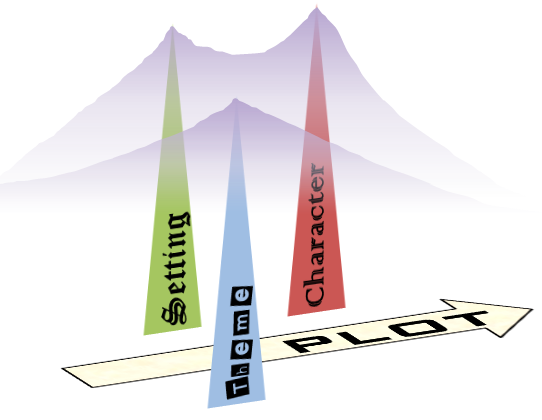
 I explained the theory of “tent-poles” in Part 1: What makes a powerful story is simply having tent-poles in the three spatial dimensions of setting, character, and theme plus the temporal dimension of plot. Little snippets of imagery for setting, dialogue/interaction for character, ideas sprinkled here and there for theme, and diagrammed events to sketch out a plot are enough.
Even if the language draped over these tent-poles is mediocre, the story will carry readers along. Take Dan Brown or George R. R. Martin as examples.
I think writers instinctively set up tent-poles when sketching out their narratives, but it helps immensely to understand the types of tent-poles. Miss one of these types, and the sketch suffers. Miss several, and you’re sketching a crap story. It also pays to keep them in mind when writing an effective summary for your query letter.
And a story blurb? Check out this format: “In a world where … [setting] … one man/woman must … [character+plot] … but can he/she do this and also … [plot+theme]?” The tent-poles are right there.
As an example, in Part 1 set up these tent-poles for the first of a hypothetical sequel trilogy in the Pirates of the Caribbean franchise. I wanted to use a world familiar to most readers so the absence of little details would not stand in the way. After you take a peek at Part 1, check out the tent-pole sketches for the next film:

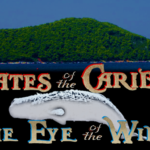
 This is going to be one part writing advice, one part literary theory, and several parts fan fiction to show how it all works.
 was, despite keeping the original plot structure, and how good the 1946 film was despite draining much of the force of the book’s plot with a Hollywoodized climax. The Bogart version succeeded, I suspect, partly due to better casting and more faithful adherence to the original witty dialogue.
 , I realized the power of wit in driving a story even when structure is weak or absent. Then, the worst of the Pirates of the Caribbean films (so far) was released on DVD. Lots to think about, and it led to the realization that there are essentially four dimensions of story-telling.


 Statehood is a perennial issue in the District of Columbia, along with full enfranchisement of the residents of DC. It’s not for nothing that the District’s license place bear the motto “Taxation Without Representation.” Unlike other Americans, citizens of DC have no effective vote in Congress.
 If you are one of my close friends, I apologize, because you have heard this rant so many times over the past year that I am probably lucky we’re still acquaintances.

 , a few

 .
.