
 pinnace, small and fast warship employed in the sixteenth century for scouting and dispatch duties.
– The Dictionary of Nautical Literacy
pinnace, small and fast warship employed in the sixteenth century for scouting and dispatch duties.
– The Dictionary of Nautical Literacy

 In part one of this series, I discussed the pros and cons of insisting on killer opening lines, how it serves the interests of agents and editors more than readers, yet how a strong first line can still lend an air of dignity and confidence to any story. In part two, I presented my favorite first lines based on engaging ideas.
Today I want to dig into my second list of Best First Lines, six of them, dedicated to openers that present the reader with an engaging character.
You might think that the “engaging character” in question would always be the first-person narrator but, as we’ll see, that’s not always the case.

 In a damn* interesting piece yesterday at Talk To YoUniverse, Juliette Wade discusses how writers can navigate the differing perspectives of characters inside and outside a culture group.
She uses her own experience as a foreigner in Japan who speaks Japanese “too well,” but lays out a set of general principles writers can use to make the meeting of any two cultures seem more authentic, whether they are writing historical fiction, fantasy, sci-fi, a modern realist tale about culture clash, or even a story about the distinctive culture of a single family.
Enjoy “Insiders and Outsiders.”
_
* Taking Mark Twain’s advice. Sans editors.

 In part one, I discussed the pros and cons of insisting on killer opening lines: how it serves the interests of agents and editors more than readers, yet also how a strong first line can lend an air of dignity and confidence to any story.
Today I want to dig into my first list of Best First Lines, six of them, dedicated to openers that present the reader with an engaging idea.
Now, don’t be quick to assume that openers based on engaging ideas are dry, intellectual, and (to writers and readers who like “human” stories) boring. Very often, this sort of opener presents an idea about human relationships, and how the characters you’re about to meet are going to stumble over it.

 I have a list of favorite opening lines from works of fiction — in four neat stacks! — but I don’t want to show them just yet. Today, I just want to settle a few things about opening lines.
Ready for a little heresy? Then, you’ve come to the right place. Let’s go!
I realize that this is one of the Ten Commandments of writing advice in this era of slushpiles runneth over, but “Thou Shalt Write A Killer Opening Sentence” is silliness.
 You’ve come a long way, baby! I mean … um … ladies.
Women have made a lot of progress over the past century, particularly in the Western world. Western readers in the 21st Century have a low tolerance for the sort of overt sexism that readers of previous eras — and in broad stretches of the map even today — would simply take for granted. This puts a lot of pressure on writers of historical fiction and fantasy set in a fictional past. How can we tell a story with female characters which won’t offend (or worse, bore) modern readers, but which also doesn’t seem hokey in its chronological context?
Well, there are at least four approaches to this dilemma…
Continue reading
verjuice _ The sour juice of green or unripe grapes, crab apples, or other fruit, especially when made into an acidic liquor. This liquor was once much used in cooking, as a condiment, and for medicinal purposes.
– A Sea of Words : A Lexicon and Companion for Patrick O’Brian’s Seafaring Tales
 At Technorati, author Jane Sadek tells a little tale from an agents conference held by the Writer’s League of Texas. Three agents all agree that a certain query submission would have been stronger if it had contained a comparative title, but how do they react to the title comparisons in the queries that follow?
Check out “Goldilocks and the Three Literary Agents.”
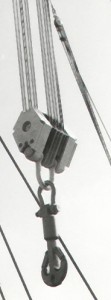 TACKLE, … a machine formed by the communication of a rope with an assemblage of blocks, and known in mechanics by the name of pulley.
Tackles are used in a ship to raise, remove, or secure weighty bodies; to support the masts; or to extend the sails and rigging.
TAIL-BLOCK, a small single block, having a short piece of rope attached to it, by which it may be fastened to any object at pleasure; either for convenience, or to increase the force applied to the said object, as explained in the first part of the article tackle.
– Wm. Falconer’s Dictionary of the Marine (1780).
tanglefoot any alcoholic drink. Refers to the effect alcohol can have on one’s ability to walk. [colloquial, mid 1800s to pres.]
– Slang and Euphemism