
Blog Archives

Archaic Definition of the Week – Nunnery

Posted on by

NUNNERY

(col.) A brothel.

The term is not as popular now as it was in Elizabethan times when nuns had more dubious reputations than they do now.

When Hamlet says to Ophelia ‘Get thee to a nunnery’ (Hamlet [III. i. 124]) it is clear from the context that he is using the word in this sense.

Wordsworth Dictionary of Obscenity & Taboo by James McDonald.

Category: ADOTW

Those Who Look Not To Like – “Juliet” & Literary Snobbery

Posted on by

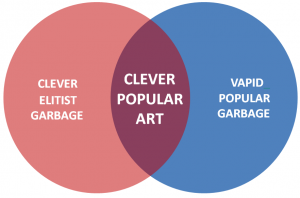
God knows I think there is a distinction between good art and bad.

Even so, I find artistic elitists, who snub as “sell-outs” anyone who drifts too far from the cleverly esoteric, to be tediously transparent in their attempt to arrogate the status of Alpha Tribe in whatever cultural kingdom they’re raising colors over.

At the Wall Street Journal, Juliet author Anne Fortier challenges the prejudices of such “literature snobs” who sniff in disdain at anything “commercial” or “ambitious.”

Although her critique does lean a bit far to the right for my radically anti-partisan tastes (characterizing public spending in a democracy as “dish[ing] out other people’s money” …. really?) it is a fun read that bops the upturned noses of the literary aristoi.

_

Extra points to the first commenter to accurately explain the title.

Category: Blogroll

Lit Quotes – Novels in Revolutionary America

Posted on by

From The Social Structure of Revolutionary America by Jackson Turner Main:

The prejudice against novels shown by North Carolina farms was not shared by men of education.  Many such books were advertised in the newspapers, and when a Yale class disputed “Whether reading of Novels be advantageous,” the President himself decided “that it is advantageous in some measure, if not much attended to.”

Neat Book Fact : Old Books and Half-Titles

Posted on by

A reader’s question to the Seattle Post-Intelligencer‘s “Booktryst” blog leads to an intriguing peek into the publishing practices of the 19th Century and before

Do you know what a “half-title” is, why they are so often missing from old books, or why their presence can cause the value of collectible books to sky-rocket?  Do you know how those elegant leather-bound books were originally bound in leather?  Do you know what’s particularly hard to find in an original printing of Pride and Prejudice (you know, the one without the zombies)?

It’s a neat read for lovers of books and the archaic.

Category: Blogroll

A (Rick) Moody Take on Publishing

Posted on by

At Big Think, novelist Rick Moody explains How the Recession has Hurt Literature.   Moody discusses the stifling effect of too many writers vying for too few publishing slots, and how self-publishing is not going to make things better.  A great interview!

Category: Blogroll

Odd Thoughts on Literary Terms

Posted on by

No, nom-de-plume is not French for “snacking on feathers.”

Category: Odd Thoughts

Now That’s a Mash-Up!

Posted on by

A couple of weeks ago, I discussed how sampling an existing novel and adding new material (ex: Pride and Prejudice and Zombies) is not technically a “mash-up” in the traditional sense.  A mash-up is a combination of two existing works into a new work, while a combination of two styles or genres would be fusion, and using pieces of a single work as part of a new work would be sampling.

Well, agent Kristin Nelson shared a true literary mash-up in her “Friday Funnies” entry at the Pub Rants blog: Jane Austen’s Fight Club.

Category: Blogroll

Archaic Definition of the Week – Canvas

Posted on by

CANVAS All sails and hammocks were made from strong-fibred hemp, the Greek ‘kannabis‘.
_

The Pirate Dictionary by Terry Breverton.

Category: ADOTW

The Authorhood of All Readers

Posted on by

Today I want to perform a philosophical genealogy, tracing today’s deluge of aspiring authors to the political and theological underpinnings of the Modern age.

Roll with me on this one; I rarely get to use my formal training in comparative religion here, and I promise this isn’t going to be a conversion blog or an Anne Rice-style rant.  So, let me state up front that this is more about tracing the path of an idea popular among present-day book enthusiasts than promoting or dismissing any of its religious or political ancestors.

Continue reading

Anis Shivani Fires A Shot Across The Bow

Posted on by

Ah finally!  After the weak and weirdly constructed assaults on literature by Lee Siegel and Philip Roth, finally I read a critique of modern publishing I can pass on as insightful rather than insipid.

Anis Shivani skewers the MFA system*, a major player in the “writer as consumer” model that’s turning publishing into a pyramid scheme.  But, Shivani’s beef isn’t with the upturning of the business model of publishing, but with the institutional dynamics that select for mediocrity:

The ascent of creative writing programs means that few with critical ability have any incentive to rock the boat–awards and jobs may be held back in retaliation. The writing programs embody a philosophy of neutered multiculturalism/political correctness; as long as writers play by the rules (no threatening history or politics), there’s no incentive to call them out. (A politically fecund multiculturalism–very desirable in this time of xenophobia–is the farthest thing from the minds of the official arbiters: such writing would be deemed “dangerous,” and never have a chance against the mediocrities.)

The MFA writing system, with its mechanisms of circulating popularity and fashionableness, leans heavily on the easily imitable. Cloying writers like Denis Johnson, Amy Hempel, Lydia Davis, Aimee Bender, and Charles D’Ambrosio are held up as models of good writing, because they’re easy enough to copy. And copied they are, in tens of thousands of stories manufactured in workshops.

The rest of the critique, including Shivani’s list of the Top 15 Most Overrated American Writers, is equally scathing, and equally valuable for anyone who wants to understand how the publishing biz is eating itself alive.

_

* I was well on my way to the MFA track when I transferred from WVSU to UVA, which would not accept my writing transfers as major credit, forcing me to choose a new major.  This happenstance may have scuttled, or hindered, my chances of being published, but in retrospect I am glad to have had years of outward-looking experience in the military and intelligence communities rather than years in a literary Hall of Mirrors.