

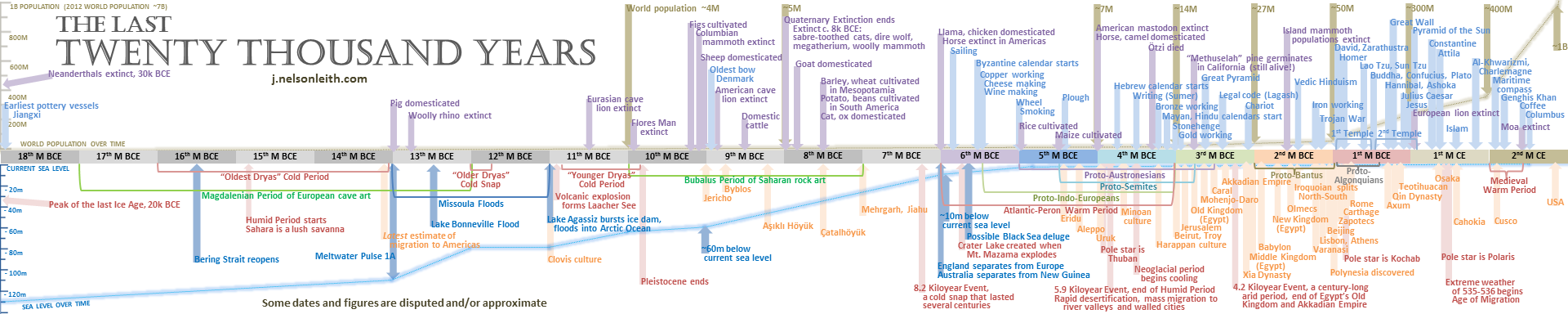
 Often, while thinking about history or historical fantasy, it can be difficult to maintain a sense of scale and proportion. We might know about European cave painting, Saharan rock art, the founding of ancient cities, and the advance of domestication. We might have a vague sense of seas rising as Ice Age glaciers melted, fluctuating climate, natural disasters, and the march of extinctions. And, we might have a sense that the various ethnic groups and ideas familiar today were not always around, but when did they begin? When did the ancient people live whose descendants became today’s Jews and Arabs, Irish and Greeks and Indians, Zulus and Swahilis, Maori and Hawaiians, Chippewa and Cheyenne, Iroquois and Cherokee?
This handy chart should help put a lot of these important historical trends, events, and persons into perspective. Of course, dates and figures in the distant past are always up for debate based on interpretation of the scientific evidence, and I have tried to include only those with the greatest support.

 In fantasy role-playing games like Advanced Dungeons & Dragons, bards are notorious for being soft in combat. They can fluff the fighters, but otherwise function as second-rate thieves and third-rate mages.
 Last week, during my son Jack’s visit, we spent a lot of time in bookstores.
 A great article on the Revolution-era ironmaster’s estate at Hopewell Furnace National Historic Site in Elverson, Pennsylvania, is now available at
 In late November of 1183 AD, the Crusader castle of Kerak was beseiged by a Muslim army led by Sultan Saláh al-Dín, or صلاح الدين — better known in English as Saladin. It was a retaliatory assault, in response to Christian knights attacking merchants.
 moments, like when Al Pacino’s detective in
  lets the mobster get away because he’s with his kids?
 by Louis B. Wright:
 Okay, so today is not the real birthday of the paperback, but it is the birthday of Sir Allen Lane, who gave us the paperback as we know it today.
 As
As  .
. by Timothy J. Shannon.